Cascada Chica and Cascada Grande: A Viewpoint-by-Viewpoint Guide to Hierve el Agua
Short answer. There are two formations. Cascada Chica is the terrace you stand on, with the pools along its lip. Cascada Grande is the taller curtain across the small valley, and it only reads properly from the footpath below the shelf — twenty to thirty minutes down, and longer back up.
Most visitors photograph one formation and walk past the other without realising it. This is the site in walking order: what you see from each point, how long each leg takes, and where the photograph everyone wants is actually taken from. What the rock is and how it was built is covered separately on the petrified waterfalls of Hierve el Agua.
The car park rim — your first two minutes
The road ends at a car park on the shoulder above the terrace, and the valley opens immediately. This is where most people take their first photograph and where almost nobody takes their best one: you are above the formation, looking down its length, and the drop that gives the place its drama is hidden by the shelf itself.
Walk on. Two minutes further and everything improves.
Cascada Chica — the terrace and the pools
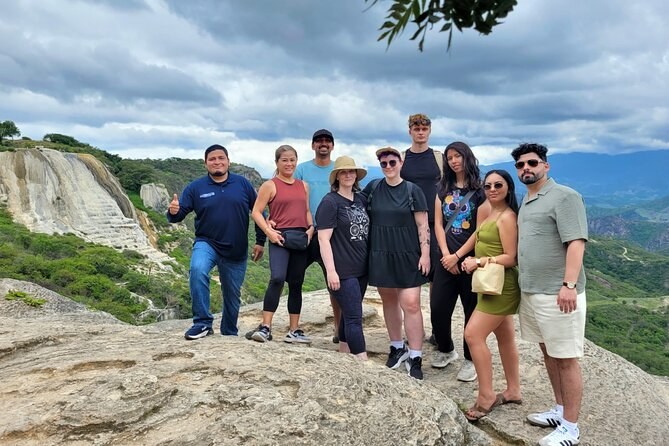
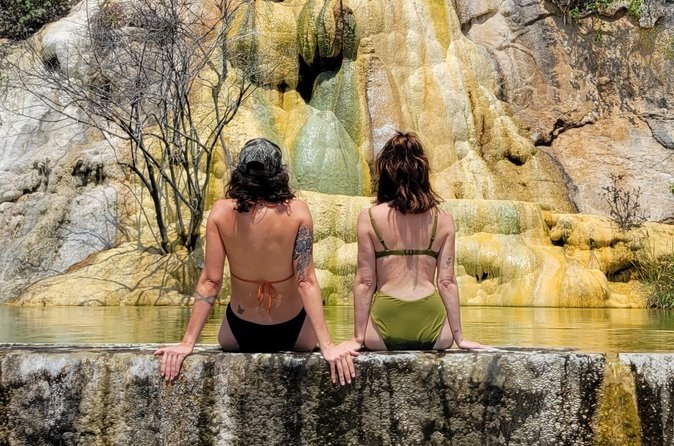
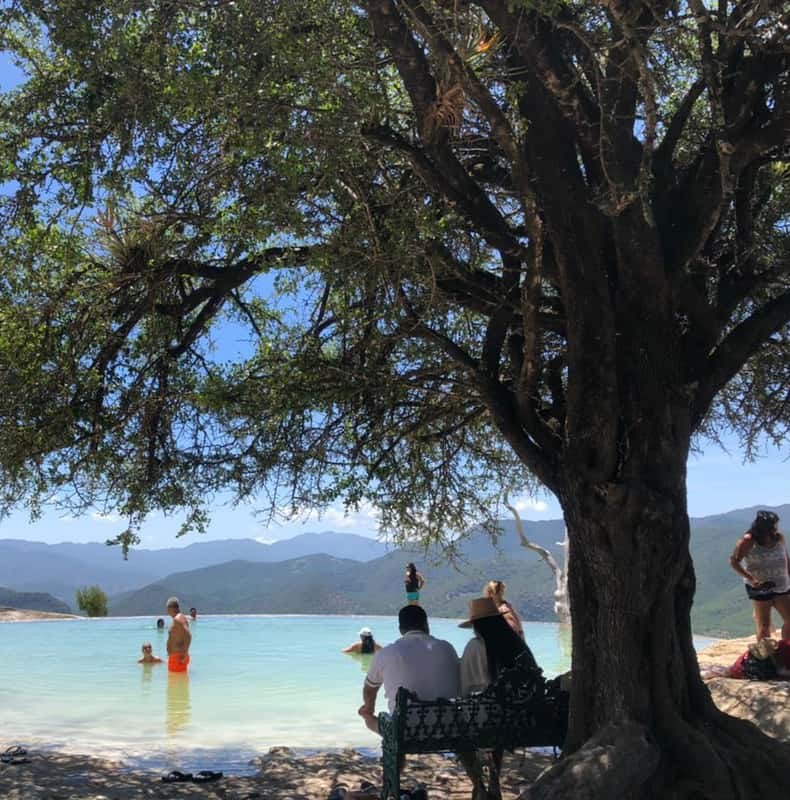
The shelf spreads out ahead: a broad platform of white travertine, ridged underfoot, wet where the springs still run across it. The pools sit along the outer lip, shallow and mineral-heavy, with nothing between them and the valley but air.
Give it twenty minutes before you get in the water. The far end of the terrace is quieter than the pool end and the view along the lip — white rock, then a thousand metres of nothing — is the one people describe afterwards.
The white is mineral, not foam. Cold springs saturated with calcium carbonate leave their load behind as the water evaporates, and the deposit has been building down this cliff for thousands of years.
The shoulder path — the side view, for a fraction of the effort
A short path runs along the top of the shelf away from the pools. It gives the terrace lip side-on, which is where the layering shows, and it costs about ten minutes. For anyone who does not want the full descent, this is the walk to do.
The descent — twenty to thirty minutes down
The main path drops off the shelf towards the base of the small valley. It is loose in places, unshaded, and steeper than it looks from the top. The view opens gradually, and the tall formation goes from a distant wall to something with texture and scale.
| Leg | Time | Ground | What it gives you |
|---|---|---|---|
| Car park to terrace | 5 min | Level, made path | The pools and the drop |
| Along the shelf | 10 min | Ridged travertine | The lip side-on |
| Shelf to lower viewpoint | 20–30 min | Steep, loose | Cascada Grande, face on |
| Lower viewpoint back up | 30–40 min | The same, uphill | The part to budget for |
Cascada Grande from below — the photograph everyone wants
From the bottom of the path the taller formation stands opposite you: a near-vertical face hung with long mineral curtains, substantially bigger than the terrace and impossible to appreciate from above. Put someone in the frame. Bare white rock photographs flat, and nothing else in the view gives it a size.
The climb back, and how to make it easy
The way up is the part people underestimate, and the fix is timing rather than fitness: do the descent in your first hour on site, while the rock is still cool, and save the pools for afterwards as a reward. Carry water down with you. The what to bring list covers what makes the difference.
What you cannot see from the terrace
Two things are invisible from the top and are the reason the descent exists. The first is the height of the tall formation, which flattens into a pale wall when you look across at it from the shelf. The second is the texture — the individual mineral curtains, the way they overlap and hang, the shadow between them.
Both only resolve once you are level with the base of the small valley. If you have ninety minutes on site, the shoulder path is the sensible trade. If you have three hours, the walk down is the reason to have booked them.
Which tours give you time for the full loop
A ninety-minute stop covers the terrace and the pools and nothing else. Three hours is the threshold where the descent becomes comfortable, and that is what the shorter, springs-focused departures publish. The longest published stop belongs to the Sunday market trip. Every departure is sorted by that column on Hierve el Agua Tours, and the choice is argued out in which tour is right for you.
What the rock is doing while you stand on it
The terrace is not finished. Water still runs across parts of the shelf, still evaporates, still leaves its mineral load behind, and the surface you are walking on is a few thousand years of that process stacked up. The ridges underfoot are growth lines.
It also explains the colour changes. Fresh deposit is bright white; older surfaces weather to cream and grey, and the green and ochre streaks are algae and iron staining where water sits. Photographs that look over-processed are usually just accurate.
Where the crowds go, and where they do not
Almost everyone follows the same line: car park, pools, photograph, back. That leaves two stretches quiet for most of the day — the far end of the terrace beyond the pools, and the whole of the lower path. Ten minutes of walking is the difference between sharing the view and having it.
Go left, then right. Walk the shelf away from the pools first while the light is low and the rock is cool, and swim on the way back. Most groups do it the other way round.
Safety on the shelf
There is no railing at the lip, and there does not need to be one — the edge is obvious and the rock is grippy where it is dry. Where it is wet, from the springs running across it, it is slick, and that is the only part worth thinking about.
Keep shoes on for the walking, watch children near the pools at the outer edge, and treat the descent as a proper walk rather than a stroll. What to wear for it is on what to bring.
Where to stand for the light
- Early morning: sun across the valley from the east, detail held in the white rock.
- Midday: flat, harsh, and the busiest hours on the shelf.
- Late afternoon: warm light on the tall formation, but you need to be off the mountain road before dark.
Practical timings for the whole day are on plan your visit.
Want the descent in your day rather than a rushed look from the top? Compare what each departure publishes for time on site at Hierve el Agua Tours.
Tours that fit this trip
Chosen for what this post covers, not for what sells.