A Day at Hierve el Agua, Hour by Hour
In this guide
- What time does the day actually start?
- What is the drive out like?
- What happens at the first checkpoint?
- What do you see first?
- How long does the walk down take?
- When are the pools quietest?
- Where do you eat?
- What is the climb back like?
- What do the valley stops add?
- What should you have in your hands, and when?
- What time are you home?
- How does the day change if you drive yourself?
- What happens if it rains while you are up there?
- What would you do differently?
What time does the day actually start?
Between seven and eight in the morning for almost every departure, and half past seven is the commonest. Two trips collect from hotels from 7:30, which means being ready at 7:15.
The early start is not padding. It is what puts you on the terrace before the mid-morning vans, and it is why the trips that leave at nine feel busier all day.
Meeting points are all within walking distance of the zócalo, and at that hour a taxi across the centre is quick and cheap. Allow fifteen minutes' margin: the vans run to a route rather than to your clock, and a late arrival on a hotel-pickup trip holds up four other groups.
Eat something first. Several itineraries make no breakfast stop and the first proper food can be six hours away, which is a detail that shapes the mood of the morning more than any other single thing.
What is the drive out like?
An hour and a half to two hours, in three distinct parts. Highway 190 runs southeast through the valley floor past Tlacolula — fast, straight, agricultural. At Mitla the road turns and starts to climb. The last section is narrow, twisting and unpaved in stretches, and it is where the time goes.
It is a scenic drive rather than a dull transfer, and on a guided trip it is where most of the context gets delivered.
What you pass, in order: the turn for Santa María del Tule and its enormous cypress, the long agave fields around Tlacolula, and then Mitla itself, where the valley narrows. After Mitla the landscape changes completely — scrub, cactus and switchbacks, with the valley floor dropping away behind you.
If you are prone to travel sickness, the last forty minutes is the part to prepare for. Sit forward in the vehicle and keep water to hand.
What happens at the first checkpoint?
Somewhere on the climb, a community checkpoint collects a road fee of roughly 20–30 pesos a person. On a guided departure the driver usually handles it; independently, you pay there and then, in cash.
It is quick, it is normal, and it is the first of two separate charges — the second is at the site itself. The full breakdown is on plan your visit.
What do you see first?
The road ends at a car park on the shoulder above the terrace, and the valley opens immediately. Most people photograph it from there, which is the one view of the day that does not really work — you are above the formation looking along it.
Two minutes further on, the shelf spreads out ahead and the pools appear at its outer lip. That is the view everyone came for.
Between the car park and the shelf is a short run of stalls selling drinks, snacks, swimwear and hats. It is the last chance to buy anything, and prices are what you would expect at the top of a mountain road.
Toilets and changing cubicles are here too, near the car park rather than at the pools. Worth registering on the way past, because coming back up wet to find them is a longer walk than it looks.
How long does the walk down take?
Twenty to thirty minutes down and thirty to forty back, on a path that is steep, loose in places and entirely unshaded. It leaves the shelf and drops towards the base of the small valley, and the taller formation opens up as you go.
Do it first, not last. Descend while the rock is still cool, climb back, and swim afterwards. Every group that reverses that order regrets it.
When are the pools quietest?
Before ten in the morning and after four in the afternoon. The middle of the day is when the vans stack up, and on a weekend or a holiday the pool end of the terrace can be busy while the far end stays empty.
The water is cool rather than cold at any hour, so the crowd matters more to the experience than the temperature does.
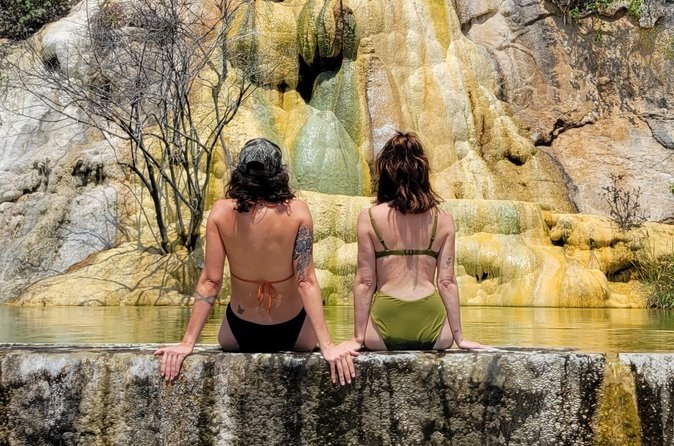
Both pools are shallow — sitting depth rather than swimming depth — and the floor is the same ridged mineral rock as the terrace. The one at the outer edge is the one in every photograph, and it is also the busier of the two.
Give it twenty minutes at the far end of the shelf before you get in. That stretch empties out as soon as the pools fill, and the view along the lip is the one people describe afterwards.
Where do you eat?
Comedores and stalls at the top of the site sell tlayudas, quesadillas and cold drinks. On a full-day circuit the scheduled meal stop is usually at a comedor or a buffet restaurant back down on the valley road, often after two in the afternoon.
Only one departure includes the meal. On the rest you order and pay, in pesos.
Expect 150 to 250 pesos a head at a valley comedor for a proper plate. The food is Oaxacan and generally good; the buffet stops on the larger circuits are more variable, and travellers say so.
If your itinerary is a springs-first trip with a single other stop, there may be no scheduled meal at all. Eat at the site or wait until you are back in the city.
What is the climb back like?
The part people underestimate, and not because it is long — because it is at 1,700 metres, in full sun, after a swim. Thirty to forty minutes at a steady pace with water in your hand, and it is a pleasant walk. Rushed, in flip-flops, at one in the afternoon, it is not.
What do the valley stops add?
On a full-day circuit, three to five of them: the Tule Tree, Mitla, a weaving workshop at Teotitlán del Valle, a mezcal palenque, and on Sundays the Tlacolula market. Each takes 40 minutes to an hour.
They are genuinely worth seeing and they are also why the springs stop shrinks. What each one involves is on what to do at Hierve el Agua.
The weaving workshop is the stop travellers most often expect to resent and most often enjoy: natural dyes demonstrated in front of you, cochineal crushed on a palm, a rug that represents weeks of work. There is a sales element and it is not aggressive.
The palenque is the same shape. Agave hearts roasting in a pit, a stone mill turned by a horse, copper stills, and a tasting. Neither stop is padding, but four of them in a day is a lot of standing and listening after three hours in the sun.
What should you have in your hands, and when?
Three moments in the day need something specific and all three catch people out. At the checkpoint on the climb you want small notes ready rather than a wallet at the bottom of a bag. At the site gate you want the same again. And on the terrace you want shoes you can walk ridged wet rock in, which is not the pair most people arrive in.
Everything else can live in the vehicle. The full list, with the condition each item answers, is on what to bring.
What time are you home?
| Shape of day | Leaves | At the springs | Back in Oaxaca |
|---|---|---|---|
| Transport-only (6 h) | ~8:00 | 3 hours | Early afternoon |
| Springs + one stop (8 h) | ~7:30 | 3 hours | Late afternoon |
| Valley circuit (10–11 h) | ~7:30 | 1.5–3 hours | Early evening |
| Long circuit (12 h) | ~7:00 | 2 hours | After dark |
The difference between finishing at four and finishing at eight is an evening in Oaxaca, which is worth putting a value on.
How does the day change if you drive yourself?
Mostly by an hour, in your favour. Without a meeting point, a pickup route or a group to assemble, the same 70 kilometres takes an hour and a half rather than two, and you arrive when you decide to.
What you take on is the two gates in cash, the parking, and a mountain descent at the end of a day in the sun. Every route is costed in getting to Hierve el Agua on your own.
What happens if it rains while you are up there?
Rain here is an afternoon event for a few months of the year, and it does not close the site. The terrace is exposed rock either way, and the pools are cool whether the sun is out or not.
What it changes is the walking: more of the shelf is slick and the lower path is greasy, so the descent becomes a decision rather than a default. The drive down afterwards is the part to take slowly.
What would you do differently?
Three things, all of them free. Walk the far end of the terrace before you swim. Do the descent in the first hour. And eat properly before you leave the city, because on several itineraries the first food stop is a long way into the day.
A fourth, which costs a little: choose a departure by its published time at the springs rather than by its total length. The difference between ninety minutes and three hours is the difference between having seen the place and having spent time in it, and it is the one variable no amount of good planning on the day can recover.
Common questions
How early do I really need to be ready?
Fifteen minutes before the stated pickup. Meeting points are in the historic centre and the vans do not wait long; hotel pickups run to a route rather than to your clock.
Can I skip the descent and still enjoy it?
Easily. The shoulder path along the top of the terrace gives the lip side-on in about ten minutes and is level the whole way.
Is there anywhere to leave a bag?
No. Take what you need and leave the rest in the vehicle, which stays in the car park with the driver on a guided trip.