The Best Time to Visit Hierve el Agua
In this guide
- What is the rainy season like?
- Do the pools change through the year?
- When is the site busiest?
- What time of day has the best light?
- Is a weekday really quieter?
- What are the holiday weeks like?
- How hot does the rock get?
- When is the road most likely to close?
- Does Sunday change anything in the valley?
- What does the dry season actually give you?
- Which month would we pick?
- What is on in the valley through the year?
- Is there a shoulder season worth targeting?
- Is there a season when swimming is better?
- Does the altitude change anything by season?
- What if you only have one free day?
What is the rainy season like?
Rain runs roughly June to September and arrives in the afternoon rather than all day. Mornings are frequently clear, which suits a site you reach at nine and leave at noon.
What the rain changes is the road, which is less forgiving wet, and the flexibility you want in a booking.
It also changes the valley. From July the agave fields and the hills around Mitla turn properly green, and the light after a storm is the best of the year for photographs. Travellers who avoid these months on principle are avoiding the prettiest version of the drive.
Practically: take a morning departure, carry something waterproof for the last hour, and accept that an afternoon stop at a palenque may happen in the rain. None of it affects the terrace, which is exposed rock either way.
Do the pools change through the year?
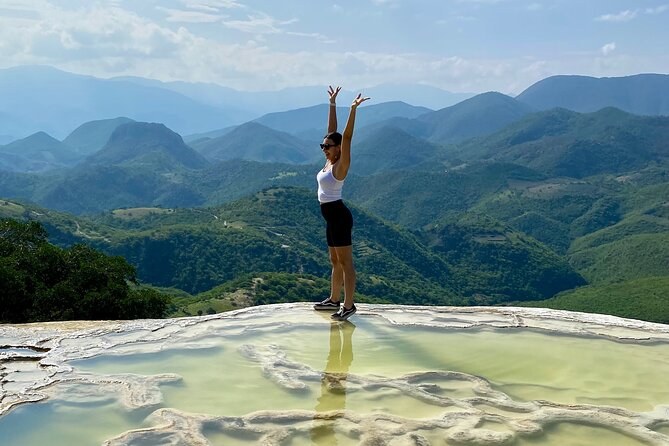
The springs run year-round and the pools hold water in every season. What changes is the surrounding colour: green and full after the rains, dry and pale gold by April.
The rock itself looks the same in January and in July, which is one reason there is no bad month here.
The springs run continuously and the mineral deposition is a process measured in centuries, so nothing about the formations is seasonal in any sense a visitor would notice. What varies is water level in the pools after heavy rain and how much of the terrace is wet underfoot.
That last point is worth a thought if you are visiting in the rains: more of the shelf is slick, and shoes with a sole matter more than usual. The list is on what to bring.
When is the site busiest?
The July Guelaguetza weeks, Semana Santa, Christmas and New Year, and every Sunday. Mexican domestic travel drives the peaks more than international arrivals do, so a Tuesday in September is quiet in a way a Sunday in December is not.
The effect is concentrated rather than general. Even in a peak week the terrace is quiet before ten and again after four; what fills is the middle of the day, when every van from the city arrives within the same ninety minutes.
One operator notes that group sizes on its shared departures can be increased during holiday periods and festivals. If a small cap is the reason you chose a trip, that is worth knowing before you book in July.
What time of day has the best light?
The first two hours after opening. Sun comes across the valley from the east and rakes the terrace, holding detail in white rock that goes flat by eleven. Late afternoon warms the tall formation, but you then face the mountain road at dusk.
Because almost every guided departure arrives between nine and ten, most visitors get the tail of that good light rather than the middle of it. The exceptions are the trips that leave Oaxaca at seven, which is a reason to choose one beyond simply getting home earlier.
Cloud is not the enemy here that it is at a viewpoint. Overcast light suits white rock, and the pools photograph better without hard shadow across them.
Is a weekday really quieter?
Noticeably. Tuesday to Thursday sees the fewest vehicles, and the difference at the pool end of the terrace is obvious. Sunday is the busiest day of the week and also the one day the Tlacolula market runs, which is a genuine trade-off rather than a simple negative.
Monday is quieter than Sunday and busier than midweek. Saturday sits between the two. None of it is dramatic, and none of it should override a good departure time: nine in the morning on a Sunday beats midday on a Wednesday.
What are the holiday weeks like?
Book earlier and go earlier. Over Semana Santa, Guelaguetza and the Christmas fortnight the small-group departures fill days ahead and the terrace is busy from ten. A 7 a.m. start is worth more in those weeks than in any other.
How hot does the rock get?
Warm enough that bare feet are uncomfortable by midday in the dry months, and the terrace has almost no shade. The altitude keeps air temperatures civil — this is not lowland heat — but the sun is strong and the white rock reflects it.
March to May is the hottest stretch and also the haziest, with dust in the valley air. It is still a fine time to come; it is simply the period when the early departure earns its keep most obviously.
What to carry is on what to bring.
When is the road most likely to close?
Closures here are political rather than seasonal, so no month is safe and no month is especially risky. They follow disputes between the communities that administer the site and the road, and they have stopped access at short notice before.
The protection is the same all year: a fare that refunds at 24 hours.
Does Sunday change anything in the valley?
Substantially. Tlacolula holds the valley's biggest weekly market on Sundays, and one departure is built around it — market in the morning, three and a half hours at the springs afterwards, the longest published stop of any trip on this route.
If your dates include a Sunday, that is the day to use for this trip.
What does the dry season actually give you?
Predictability, mostly. From November to April an afternoon plan is a plan rather than a hope, the mountain road is dry, and the light is consistent from one day to the next. It is the reason most visitors come in these months.
What it costs is colour. The valley is pale gold and dusty by March, the agave fields are grey-green, and the air over Oaxaca hazes in the afternoons. Photographs from November and photographs from April look like different places.
Neither is better. The dry months are the safer booking; the wet months are the prettier drive, and the terrace itself is indifferent to both.
Which month would we pick?
| Months | Weather | Crowds | What to expect |
|---|---|---|---|
| Nov–Feb | Dry, clear, cool mornings | Busy at Christmas | The most reliable conditions |
| Mar–May | Dry, hot, hazy | Peaks at Semana Santa | Golden valley, strong sun |
| Jun–Aug | Afternoon rain | Guelaguetza peak in July | Green valley, clear mornings |
| Sep–Oct | Wettest, then clearing | Quietest of the year | Dramatic skies, empty terrace |
November is the pick: dry, green after the rains, and before the Christmas crowds. If your dates are fixed and land in the wettest weeks of September, book anyway and take a morning departure — the terrace is worth the trip in any month, and September mornings are frequently clear before the afternoon builds. What changes with the season is the drive and the crowd, not the rock.
What is on in the valley through the year?
Guelaguetza fills the last two weeks of July with dance from every region of Oaxaca, and it is the busiest the city gets. Day of the Dead at the start of November is the other peak. Semana Santa moves with Easter and empties Mexico City into Oaxaca.
All three are excellent reasons to be here and poor weeks to expect an empty terrace. If your dates are fixed to a festival, take the earliest departure you can find.
Is there a shoulder season worth targeting?
Two of them. Late October into November, once the rains have finished and before the Christmas influx: green valley, clear air, few vehicles. And late January into February, dry and quiet with cool mornings.
Both give you the terrace close to empty at nine in the morning, which is the single biggest variable in how the place feels.
Is there a season when swimming is better?
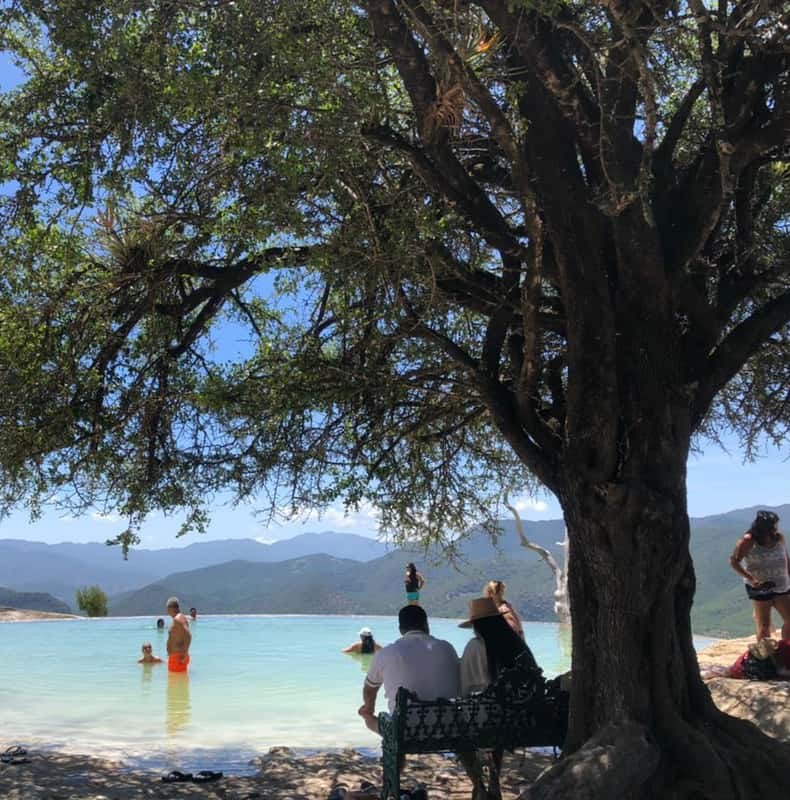
The water does not change, so the answer is about air temperature rather than the pools. In the dry months from March to May the middle of the day is warm enough that getting in is a relief; in December and January the same swim at nine in the morning is bracing.
Nobody is stopped by it either way. Bring a towel and a change of clothes in every month — mineral water dries chalky whatever the season.
Does the altitude change anything by season?
The site sits at roughly 1,700 metres and Oaxaca itself is a little higher, so air temperatures stay moderate even in the hottest months. What altitude does do, all year, is strengthen the sun and cool the mornings.
In December and January the first hour after opening can be genuinely cold on an exposed terrace, and the vans leave the city in the dark. From March the same hour is the pleasantest of the day. Either way the answer is layers you can shed rather than a heavier coat.
The other altitude effect is the climb back from the lower viewpoint, which feels harder than the same gradient at sea level in every season. That is a reason to walk it early, not a reason to skip it.
What if you only have one free day?
Take it whatever the forecast says. Rain here is an afternoon event and the terrace is worth seeing in any weather; the pools are cool in every season anyway.
Book a departure that leaves early and gives you three hours on site, and keep the free cancellation intact in case the forecast turns catastrophic rather than merely wet. Every departure is compared on Hierve el Agua Tours.
Common questions
Is Hierve el Agua worth visiting in the rainy season?
Yes. Rain arrives in the afternoon, the mornings are often clear, and the valley is at its greenest. Take a morning departure and keep the 24-hour cancellation.
Does the site ever close for weather?
Not routinely. Closures here have been about access disputes rather than rain, and the site keeps 7 a.m. to 6 p.m. hours through the year.
When is the water warmest?
It barely changes — the springs run cool all year. What changes is the air, so the pools feel best in the middle of a dry-season day.